What Is the Right ORB Target? Five Rules Tested on 100,569 Identical Entries
We ran the same 100,569 opening range breakout entries through five target rules. The half-range target won 66% but earned least, stretching to 1.5x risk lost ground, and the plain full-range target made the most money.
FAIL: error: no such post
Published July 22, 2026
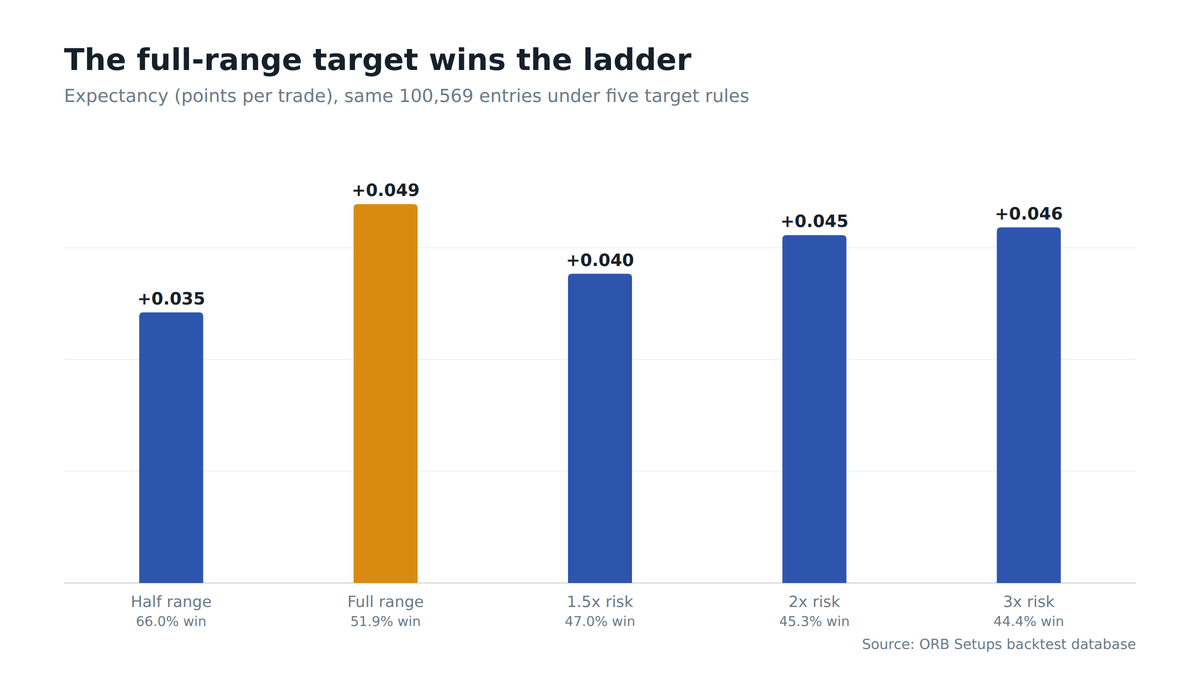
Every opening range breakout trader faces the same question after entry: where does this trade get paid? We ran the identical 100,569 15-minute ORB long entries through five different target rules, and the boring full-range target made the most money.
Five targets, one set of entries
Every row below comes from the same controlled test. Three things never change:
- Same entries: the identical 100,569 long breakouts across two years, on the same symbols.
- Same stop: the full range, every trade, every rule.
- Same direction: longs only. Only the profit target moves.
Win rate and expectancy move exactly the way theory predicts. Total profit does not.
| Target | Win rate | Expectancy (pts/trade) | Total P/L (pts) |
|---|---|---|---|
| Half the range | 66.0% | +0.035 | 3,579 |
| Full range | 51.9% | +0.049 | 4,847 |
| 1.5x risk | 47.0% | +0.040 | 3,979 |
| 2x risk | 45.3% | +0.045 | 4,455 |
| 3x risk | 44.4% | +0.046 | 4,669 |
The two temptations, measured
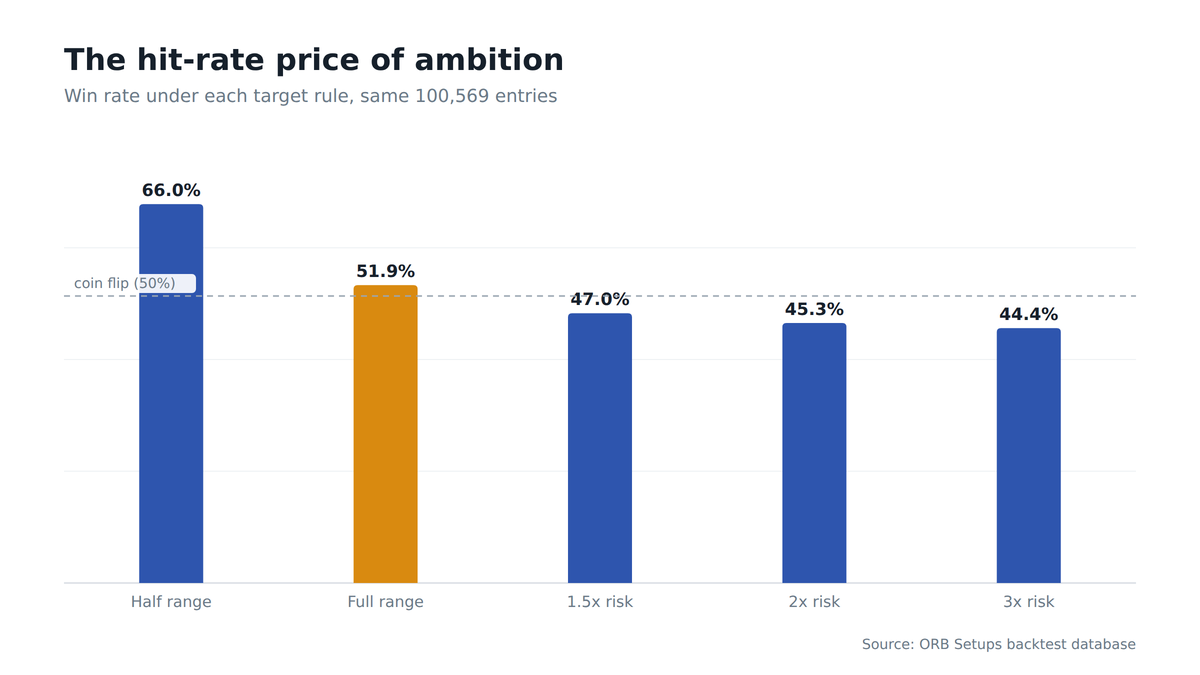
The first temptation is the high win rate. Taking profit at half the range wins two trades in three, and it feels wonderful.
It is also the worst-paying rule in the table. The winners are half-sized while the losers stay full-sized, and the arithmetic never forgives that.
The second temptation is the home run. Stretching the target to 1.5x risk actually loses money relative to the full range: the win rate drops six points and expectancy falls, because a meaningful slice of trades that would have paid at the full range reverse just past it.
Push further, to 2x and 3x, and expectancy climbs partway back as the occasional monster compensates. But even the 3x rule never catches the plain full-range target on expectancy or on total profit.
Why the full range is the natural target
There is a logic to it. The opening range is the market’s own measurement of what this stock considers a meaningful move today.
Projecting that same distance from the breakout asks for exactly one more unit of what the morning already demonstrated. Prices reach for it more reliably than for any multiple a trader imposes from outside.
The shape of the ladder tells the story:
- The dip at 1.5x: the fingerprint of moves exhausting just past their measured distance.
- The partial recovery at 3x: the long tail of trend days doing the heavy lifting.
- The peak at 1x: the market pays its own measurement best.
What we would actually change
If your temperament genuinely cannot tolerate 48% losing days, the half-range target is a legitimate psychological trade. You pay about 29% of the system’s profit for fourteen extra points of win rate, and knowing the price makes it a fair purchase.
What the data argues against is the middle path of quietly stretching targets to 1.5x or 2x in search of better risk-reward.
The measured answer for this configuration is the simplest one. The range sets the stop, the range sets the target, and the market pays that symmetry best.
The fine print
- All standard caveats apply: this is a backtest of one configuration, long entries with a full-range stop.
- Your ticker may differ: the per-symbol pages let you check whether your favorite ticker deviates from the universe on this.
Keep reading
Frequently asked questions
What is the best profit target for opening range breakout trades?
The full-range target earned +0.049 points per trade, the highest expectancy of the five rules tested on 100,569 long entries. Projecting the opening range’s full distance from the breakout beat both the tighter half-range target and every larger risk multiple on expectancy and on total profit.
Does taking profit at half the opening range make more money?
No. The half-range target won 66.0% of trades but earned just +0.035 points each, the lowest expectancy in the test, for 3,579 total points. Its winners are half-sized while losers stay full-sized, so the high hit rate feels good but pays the least.
Is a 2x or 3x risk-reward target better for ORB profit?
No. The 2x rule made 4,455 total points and the 3x rule made 4,669, both below the full-range target’s 4,847. Expectancy climbs partway back at these multiples as occasional large winners compensate, but neither catches the plain full-range target.
Why does stretching the ORB target to 1.5x risk lose money?
At 1.5x risk the win rate drops six points to 47.0% and expectancy falls to +0.040, below the full range’s +0.049. A meaningful slice of trades that would have paid at the full range reverse just past it, the fingerprint of moves exhausting near their measured distance.
How many trades were used to test ORB profit target rules?
The study ran the identical 100,569 15-minute ORB long entries across two years through five different target rules. The entries, the full-range stop, and the long-only direction stayed fixed for every rule, so only the profit target changed between results.
What win rate should I expect with a full-range ORB target?
The full-range target won 51.9% of trades, sitting just above the coin-flip line while delivering the test’s best expectancy of +0.049 points per trade. The tighter half-range target won more often at 66.0%, but you pay about 29% of the system’s total profit for that comfort.
Frequently Asked Questions
Related Research
Opening Range Width: The U-Curve Hiding in 105,000 ORB Trades
We bucketed 105,000 15-minute opening range breakout trades by range width. Tight ranges won most often, ranges over 4% of…
Aug 21, 2026The Most Consistent ORB Stocks: A Two-Year Leaderboard
The strongest 15-minute opening range breakout performers of the last two years: twelve symbols that won 60% or better across…
Aug 14, 2026The Best Day of the Week for ORB Trades: 207,000 Backtests by Weekday
We split 207,000 15-minute opening range breakout trades by weekday and direction. Monday favored longs, Wednesday quietly flipped to shorts,…
Aug 5, 2026Trade with data.
Not hope.
640+ stocks and ETFs, updated every 2 minutes during market hours. Every setup shows its 90-day win rate.
Start Your Edge